

A zero-incident safety culture means every task in a data center from high-voltage maintenance to routine housekeeping is planned, permitted, and supervised so no one is harmed. At Techno Digital, this is built through pre-work risk assessments, permit-to-work controls, a buddy system for high-risk tasks, toolbox talks, mock drills, and leadership safety walks across its Chennai, Gurugram, and Mumbai facilities.
Techno Digital’s Recent Safety Report Snapshot
| Safe work hours logged | 2,35,445 across Chennai, Gurugram & Mumbai |
| First-aid, recordable, lost-time | Zero across all three facilities |
| Total Recordable Incident Rate (TRIR) | 0.00 |
| Worst Potential Severity (WPS) Rate | 0.00 |
| Toolbox talks, permits to work, training sessions | Held routinely across all sites, with 100% closure tracking on observations |
At the end of every shift, beyond the operating logs, maintenance schedules and performance dashboards, there is one outcome that matters more than any other: every person who entered the facility should return home safely.
This belief shapes how Techno Digital approaches safety in mission-critical data center operations. In an always-on business, the word “zero” can easily become another number in a monthly report. For us, it represents the engineer working near high-voltage equipment, the technician maintaining a cooling system, the housekeeping professional keeping a work area free from hazards, and the families who expect them home at the end of the day.
Our ambition of zero incidents is not driven by compliance alone. It is grounded in respect for human life. It asks us to anticipate what could go wrong, create the right safeguards before work begins, and give every person the confidence to speak up about concerning conditions.
What Does “Zero Incidents” Mean in Data Center Operations?
Data centers are designed to operate continuously, but the work behind that continuity is deeply human. Teams interact with electrical systems, generators, batteries, cooling infrastructure, fire-protection equipment and restricted technical areas every day. The smallest overlooked condition can affect a person, a piece of equipment, or the continuity customers depend upon.
A zero-incident culture cannot begin after an event, it has to begin at the planning stage, before a permit is issued, before equipment is opened, and before a team enters a high-risk area. Method statements, risk assessments, high-risk activity planning, and permit-to-work (PTW) controls help teams think through the activity in advance:
- What are the hazards?
- Who could be affected?
- What must be isolated?
- What protective equipment is required?
- What should happen if conditions change?
This preparation is not paperwork surrounding the job, it is part of the job itself. It creates the pause in which risk becomes visible and preventable.
A Result Built Through Daily Discipline
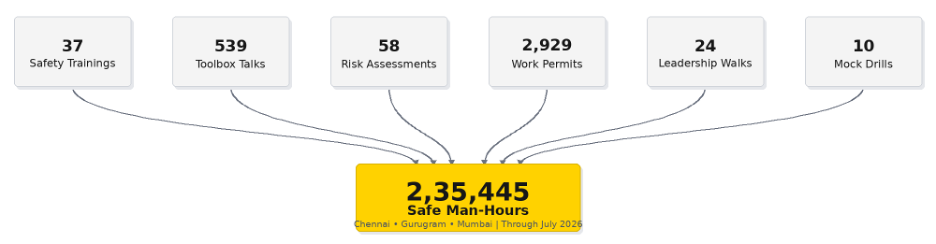
Across Techno Digital’s Chennai, Gurugram, and Mumbai facilities, teams completed 2,35,445 safe work hours — 2,22,473 at Chennai, 6,300 at Gurugram Edge Data Center, and 6,672 at Mumbai Edge Data Center.
During these hours, the facilities recorded zero first-aid cases, zero recordable incidents, zero lost-time injuries, zero serious or potentially serious incidents, one reported near misses, and zero property-damage cases. The Total Recordable Incident Rate (TRIR) and Worst Potential Severity (WPS) Rate both stood at 0.00.
These numbers matter, but not because they let us declare the work finished. Safety is never finished. They matter because each number reflects thousands of individual decisions: a worker wearing the correct protection, a supervisor stopping an unsafe activity, a team correcting a hazard, or a leader taking the time to listen on the floor.
Seeing Risk Before It Becomes an Incident
A mature safety culture does not assume that a clean incident record means hazards no longer exist. It assumes the opposite: risk remains present and must continue to be looked for.
Our safety observation process classifies concerns as low, moderate, or high risk so that the response matches the urgency. Observations are communicated and assigned for corrective action within 24 hours, while serious concerns particularly those involving fire require immediate escalation and same-day attention wherever operationally possible.
Recent examples from the field illustrate this in practice: chemicals found stored improperly were treated as a potential safety and environmental risk; a metal rod protruding from a concrete surface was flagged as a trip and injury hazard; and a cleaning and record-keeping schedule was recommended for drinking-water tanks. Each observation mattered because safety spans electrical and fire protection, housekeeping, hygiene, and worker welfare alike.
The principle is simple: never walk past a condition that could harm someone later. Reporting a concern is treated as responsibility, not criticism. When employees know that raising an observation leads to action rather than blame, safety becomes something the workforce owns together.
No One Should Face a High-Risk Task Alone: The Buddy System
The human dimension becomes especially important in high-risk technical rooms. Techno Digital’s buddy-system approach ensures personnel do not work alone during critical activities. At least two people remain present: one performs the task while the other maintains awareness, verifies safe practice, and can respond or escalate immediately if conditions change.
It is a straightforward control, but it reflects an important belief: working together can be the difference between a controlled deviation and an emergency. It also reminds every individual that asking for support is not a weakness in safety-critical work, it is professional judgment.
The same discipline applies to welding and other hot work, which cannot begin without an approved permit, an isolated work area, appropriate personal protective equipment, fire-prevention controls, and proper housekeeping before and after the task. For work in changing conditions such as cable laying inside an active data hall dynamic risk assessment helps the team reassess the environment as the activity progresses, rather than relying only on assumptions made at the start.
Training at the Moment It Matters
Formal training creates knowledge, but daily engagement turns knowledge into behavior. Toolbox talks are held close to the point of work, when the information is immediately relevant. Before an activity begins, teams discuss responsibilities, task-specific hazards, required protection, safe operating steps, emergency response, and the conditions under which work must stop.
Focused training sessions conducted during the July 2026 reporting period covered electrical safety, preventive maintenance, and machine guarding/protective measures. Emergency preparedness was further strengthened through an earthquake simulation drill, lift interruption drill, fire mock drill, and chemical spill awareness training.
Mock drills are not rehearsals for fear; they are rehearsals for clarity. They help teams understand who must act, how quickly information should move, whether evacuation routes work as intended, and how engineering, security, operations, and HSE personnel coordinate under pressure. Practicing in advance gives people a better chance of responding calmly when every second matters.
Recognition Paired With Accountability
People repeat what an organization consistently notices. In June 2026, eight technicians, shift engineers and six housekeeping team members were recognized for safety adherence. Such recognition tells the workforce that careful behaviour is valued not only when it prevents a major event, but also when it appears in the quiet, correct decisions made every day.
Recognition, however, must be paired with accountability. A lapse such as failing to wear required protective equipment cannot be ignored simply because no injury occurred. Depending on the seriousness and recurrence of the violation, the response may progress from direct counselling.
The purpose is to protect the individual, protect colleagues, and prevent unsafe behaviour from becoming normal. A responsible culture knows how to appreciate people who do the right thing while intervening firmly and fairly when standards are disregarded.
Why Leadership Must Be Visible on the Floor
Safety culture is weakened when it exists only in instructions sent from an office. Leadership safety walks bring decision-makers closer to the environment in which work is actually performed. They create opportunities to observe conditions directly, understand operational pressures, hear concerns from employees, and remove obstacles that a procedure alone may not reveal.
For leaders, being present on the floor sends an important message: no deadline, maintenance window, or performance target is more valuable than a person’s wellbeing. It also makes safety a shared operational responsibility rather than the responsibility of the HSE team alone.
The Promise Behind Zero
Zero incidents does not mean zero risk. It means risk is met with preparation, supervision, training, teamwork, and the willingness to intervene. It means treating a permit as a safeguard, a toolbox talk as a conversation, a mock drill as preparation, and a reported observation as an opportunity to protect someone.
For Techno Digital, this commitment also strengthens operational resilience. Protecting people helps protect equipment. Protecting equipment reduces the possibility of disruption. Preventing disruption safeguards the trust customers place in infrastructure that must remain available around the clock.
Yet the most important outcome remains human. Behind every safe man-hour is a person whose wellbeing cannot be reduced to a statistic. Our responsibility is to create an environment in which people can perform complex, essential work with confidence and return safely to the lives waiting for them beyond the facility.
That is what zero means to us. Not the absence of something to report, but the presence of care in every decision we make.
