
The first phase of the AI infrastructure race was defined by acquisition, how many GPUs could be secured, how many megawatts could be commissioned, and how quickly a campus could go from groundbreaking to live. That race isn’t over. But underneath it, a quieter and potentially more consequential race has begun: the race to make that capacity economically productive.
Consider two numbers. In March 2023, a GPT-4-class model cost roughly $20 per million tokens to run. Today, that same intelligence costs less than $0.50, a decline of nearly 98% in three years. Over roughly the same period, the average enterprise AI budget has grown nearly 6x, from $1.2 million to approximately $7 million.
Put those numbers next to each other and an interesting paradox emerges: intelligence has never been cheaper, yet AI has never cost more.
That paradox is becoming one of the defining stories of AI infrastructure in 2026. And it is why, at Techno Digital, we believe the infrastructure question is also changing from how much capacity can we build to how much usable intelligence can that capacity actually deliver, per rupee, per watt and per second.
This is the shift from measuring capacity to understanding the Cost of Intelligence.
| 98%Fall in cost per token | 6XGrowth in average enterprise AI budget | 90% Of AI spend is now catering inference | 24xProjected token demand growth by 2030 |
From Capacity to Productivity
The first phase of the AI infrastructure race was necessarily about capacity. Compute was scarce, demand was accelerating, and hyperscalers, enterprises and governments moved quickly to secure GPUs, power and data centre capacity.
That capacity remains essential, but capacity by itself does not determine AI economics. A GPU cluster operating at high utilisation has very different unit economics from the same cluster sitting partially idle. The same is true of the power, cooling, networking and facility infrastructure supporting it.
The question is therefore evolving from how much compute is available to how productively that compute can be converted into usable intelligence. In that shift, utilisation, throughput, energy efficiency and workload placement become as strategically important as installed capacity itself.
Real Scenario where Cost of Intelligence is Being Fought Over
| Cheaper Intelligence Doesn’t Mean Less Spending Earlier this year, a widely circulated figure claimed DeepSeek had trained a frontier model, DeepSeek-R1, for just $5.6 million. That number actually referred to the final pre-training compute estimate for DeepSeek-V3, not the total cost of developing or training R1, a meaningful distinction that got lost in the headlines. Weeks later, Microsoft, Meta, Amazon, and Google all reaffirmed or increased their AI capex guidance rather than cutting it.This is a clean illustration of Jevons’ paradox: when efficiency gains lower the price of a resource, total consumption of that resource tends to rise rather than fall. Every rupee saved per token becomes the reason to run ten more tokens in parallel, not the reason to build less. | The Price of a GPU Is Not the Cost of Intelligence NVIDIA’s own Blackwell-vs-Hopper analysis shows Blackwell costs roughly 2x more on a raw FLOPS-per-dollar basis. Yet the actual delivered cost per million tokens comes out nearly 35x lower, not higher because Blackwell delivers over 50x more tokens per watt through architectural and software gains.The takeaway: buyers evaluating infrastructure on chip price or FLOPS-per-dollar alone are optimizing the wrong number. The true cost of intelligence is determined by delivered tokens per watt, not FLOPS per dollar. |
For high-density AI environments, rack power levels are moving far beyond traditional data center ranges making liquid cooling and advanced power architecture increasingly essential.
The New Metric: Cost of Intelligence
Each AI workload consumes infrastructure very differently. In terms of operations, the processor executes the model, but the surrounding ecosystem determines how effectively each megawatt is converted to usable intelligence. Hence, this kind of difference is redefining the AI economics. As agentic workloads become more common and dominant, the core planning metrics are shifting toward cost per token, per inference, and per workflow.
The inference cost is the cost of generating outputs and running AI models, as opposed to training cost, which is paid once for model creation. The metrics are measured in dollars per million tokens for LLMs, dollars per image for image generation, and dollars per second for audio and video generation. It is the backend operational cost that determines the unit economics and has declined dramatically in the year 2026, almost by 100x. Reason for this is mainly the model efficiency improvements, hardware advances, and competitive pricing pressure.
The Cost of Intelligence Stack
The cost of intelligence is not created at any single layer. It is the cumulative result of decisions made across the entire AI stack.
Model efficiency determines how much computation is required to produce an output.
Compute architecture determines how efficiently accelerators, memory and interconnects execute that workload.
Utilisation and orchestration determine how much of the installed infrastructure is doing productive work rather than sitting idle.
Infrastructure efficiency determines how effectively power, cooling and facility capacity support high-density compute.
Workload placement determines the network, latency and data-movement economics of where intelligence is produced and consumed.
These layers converge into one outcome: the cost of delivered intelligence. That’s why optimizing only one layer can produce misleading economics. A highly efficient model running on poorly utilized infrastructure can still be expensive. The fastest accelerator can lose its advantage if constrained by memory, networking, or power. And low-cost compute located far from a latency-sensitive workload may not be the lowest-cost outcome at all.
Cost of intelligence is a stack-wide metric, not a hardware metric.
How is the Cost of Intelligence Calculated?
The least useful number in the entire equation is a GPU’s list price — yet most conversations about AI infrastructure stop there. The figure that actually determines competitiveness is the delivered cost per million tokens, and it’s a function of three variables:
Cost per million tokens = GPU Cost per Hour ÷ (Utilization Rate × Sustained Throughput in tokens/hour) × 1,000,000
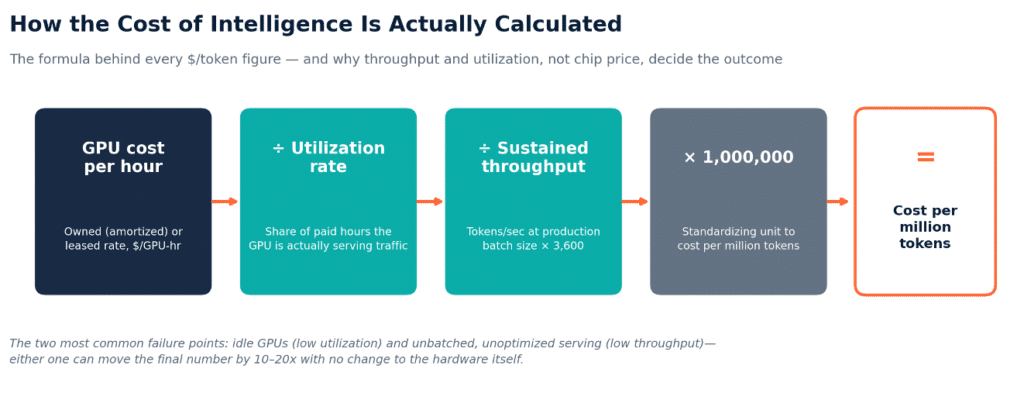
In practice, this means the winning model for AI infrastructure is rarely one giant build. It’s phased capacity, backed by committed demand, high utilization, and power-secured sites — an approach that ensures each additional megawatt or GPU cluster improves unit economics rather than inflating them. The operators that succeed will be those who can expand in step with demand while keeping workload economics under control.
This is also why AI infrastructure design must now include orchestration, scheduling, memory tiers, workload placement, cooling design, and interconnect efficiency as core disciplines not afterthoughts. Efficiency is no longer just a facilities issue; it’s a stack-wide issue. The biggest hidden cost is often not the hardware itself, but infrastructure sitting idle or underused.
If Chips Keep Getting More Efficient, Why Does Power Matter More?
NVIDIA’s Blackwell Ultra GB300 NVL72 is a fully liquid-cooled rack unifying 72 Blackwell Ultra GPUs and 36 Grace CPUs, already delivering 1.5x the dense FP4 throughput and 2x the attention performance of the original Blackwell generation, purpose-built for reasoning and test-time-scaling inference workloads.
The next generation goes further with Vera Rubin – NVIDIA’s VR200 platform confirmed for the second half of 2026 that consolidates 288 GB of HBM4 memory at 22 TB/s of bandwidth, 2.8x Blackwell’s figure, and delivers 50 PFLOPS of FP4 compute, a 3.3x throughput jump over GB300 in the memory-bandwidth-bound workloads that dominate modern AI serving. Early benchmark disclosures (CoreWeave, using DeepSeek R1 as the reference model) support that multiple for inference throughput. NVIDIA’s own projection up to a 10x reduction in AI inference cost once Rubin racks are at scale, which, for an operator running GB300 today, translates into either a 3x reduction in rack count or a 3x increase in tokens served from the same floor space, power draw, and networking footprint.
Does power matter more, or less, as chips get more efficient? The evidence says emphatically more. An average data center rack density has gone from roughly 7 kW in 2021 to about 27 kW in 2026 and the newest AI racks already draw 132–246 kW, with 900 kW to 1 MW designs on NVIDIA’s own roadmap for 2027. Every efficiency gain at the chip level has been reinvested into denser racks, not lower power draw.
This is precisely why power and not chip supply is now the binding constraint on AI infrastructure. Furthermore, global data center electricity demand is projected to reach approximately 132 GW in 2026, climbing toward 290 GW by 2030 as per Gartner. In several major markets, securing new grid interconnection capacity now takes three to four years, much longer than it takes to physically construct the facility. Time-to-power has become as critical a planning variable as time-to-deployment, and it is reshaping where operators choose to build, not just how.
Where Intelligence Runs is Becoming an Economic Decision
Cost of intelligence is also changing how we think about the geography of compute.
Not every AI workload has the same infrastructure requirement. Large-scale training benefits from concentrated compute and high-speed interconnects in hyperscale environments. Many large inference workloads can operate efficiently from centralized or regional infrastructure. But latency-sensitive enterprise, industrial, and real-time applications create a different equation, one where moving large volumes of data back and forth to distant infrastructure introduces latency, bandwidth costs, and unnecessary data movement. Processing or filtering workloads closer to where data is generated can improve responsiveness and, for the right use case, change the economics of delivery entirely.
The infrastructure question, then, is more nuanced than simply choosing between hyperscale and edge. It becomes: where should each workload run to deliver the required outcome at the right combination of cost, latency, resilience, and governance?
This is why the emerging AI infrastructure architecture is likely to be increasingly interconnected and distributed, large-scale compute at the core, complemented by regional and edge capacity closer to where intelligence is actually consumed.
Why India can Build Differently?
India has a real opportunity to shape a different AI infrastructure model. Instead of chasing only the largest training clusters, the country should prioritize affordability, shared access, multilingual use cases, and power-aware deployment across distributed digital infrastructure. That would allow India to turn compute into usable intelligence at a lower cost per task, while also addressing grid constraints, cooling needs, and data locality.
India also enters this phase with structural advantages: expanding renewable energy capacity, competitive power economics, strong engineering talent, and one of the world’s fastest-growing digital ecosystems. Combined with liquid-cooling-first facility design and disciplined utilization economics, these advantages can support an AI infrastructure stack that is more distributed, more efficient, and more inclusive than a purely hyperscale model while directly targeting the layers in the Cost of Intelligence Stack that India can most credibly control: power sourcing, thermal design, and orchestration. It’s the design principle we’ve built Techno Digital’s own approach around, and the one we believe the rest of the industry will follow.
The industry has spent the past few years celebrating GPUs deployed and megawatts commissioned. Those milestones remain important, but they are no longer sufficient. The next measure of leadership will be how much usable intelligence every unit of infrastructure can deliver.
